
Three Anchor Bay wildlife

Meet the locals before you paddle

Three Anchor Bay sits inside the Table Mountain Marine Protected Area, and the neighbours are remarkable. Every animal below is an interactive 3D model — drag to spin it around, and tap the numbered dots to learn what each part of its body does.

  • Year-roundDrag to spin · tap the numbers

    Heaviside’s dolphin

    Cephalorhynchus heavisidii

    Size~1.7 m — one of the world’s smallest dolphinsEatsJuvenile hake, squid and octopusBest timeCalm early mornings, all year

    Did you knowThey live nowhere else on Earth but the Benguela coast of South Africa and Namibia — and they love surfing kayak bow waves.
  • Year-roundDrag to spin · tap the numbers

    Dusky dolphin

    Lagenorhynchus obscurus

    Size~2 mEatsAnchovies, sardines and squidBest timeSummer mornings, in pods that can number hundreds

    Did you knowThe acrobats of the bay — duskies are famous for somersaults, back-flips and leaping clean out of the water beside the kayaks.

  • Summer & autumnDrag to spin · tap the numbers

    Long-beaked common dolphin

    Delphinus capensis

    Size~2.5 mEatsSardines and anchoviesBest timeSummer and autumn, when the bait fish run

    Did you knowThey travel in pods that can number in the hundreds — when one sweeps through after sardines, the whole bay seems to boil.

  • Jun – NovDrag to spin · tap the numbers

    Southern right whale

    Eubalaena australis

    SizeUp to 15 m and 40 tonnesEatsKrill and copepods, filtered through baleenBest timeWinter and spring, when they calve in Cape waters

    Did you knowThey swim ~2 500 km from sub-Antarctic feeding grounds to breed here. The white callosity patterns on their heads are as unique as fingerprints.

  • May – DecDrag to spin · tap the numbers

    Humpback whale

    Megaptera novaeangliae

    SizeUp to 16 m and 30 tonnesEatsKrill and small shoaling fishBest timeSpring, at the peak of the migration

    Did you knowThousands stream past on migration between Antarctic feeding grounds and tropical breeding waters — and no whale breaches more spectacularly.

  • Year-roundDrag to spin · tap the numbers

    Cape fur seal

    Arctocephalus pusillus

    SizeMales up to 2.3 m and 300 kgEatsFish, squid and octopusBest timeAlmost every trip, all year

    Did you knowThe bay’s official welcoming committee — curious young seals often swim upside down beneath the kayaks to get a better look at you.

  • Nov – AprDrag to spin · tap the numbers

    Ocean sunfish

    Mola mola

    SizeUp to 3 m fin-to-fin and over 1 000 kgEatsJellyfish, mostlyBest timeWarm, still summer days

    Did you knowThe heaviest bony fish on Earth. It drifts on its side at the surface to warm up after deep dives — which is how it got its name.

  • Year-roundDrag to spin · tap the numbers

    Compass jellyfish

    Chrysaora spp.

    SizeBell up to ~30 cm acrossEatsPlankton and tiny fishBest timeClear water, with summer blooms

    Did you knowNamed for the brown compass markings on the bell. They drift with the current — and they’re the sunfish’s favourite snack.

  • Year-roundDrag to spin · tap the numbers

    African penguin

    Spheniscus demersus

    Size~65 cm tallEatsSardines and anchoviesBest timeOccasional visitors, commuting past the kayaks

    Did you knowThey breed nowhere but South Africa and Namibia, at about two dozen colonies — five of the most important are along this coast.

  • Critically Endangered since 2024

    Where African penguins nest

    Fewer than 10 000 breeding pairs were counted in 2023. Five key colonies, from west to east:

    1. Dassen Island off Yzerfontein

      An estimated 1.45 million birds in 1910, about 30 000 by 1990. Egg collecting was a major cause.

    2. Robben Island Table Bay

      The closest colony to Three Anchor Bay. Penguins returned in 1983, passed 8 000 pairs in the mid-2000s, then crashed to around 1 000.

    3. Boulders Beach Simon’s Town

      A mainland colony in Table Mountain National Park. It started from just a few birds in the 1980s.

    4. Stony Point Betty’s Bay

      One of the largest colonies left, in a CapeNature reserve. Visitors watch from a boardwalk.

    5. Dyer Island near Gansbaai

      Teams rescue chicks abandoned when their parents start to moult. They’re raised at a Gansbaai sanctuary, then returned to the island.

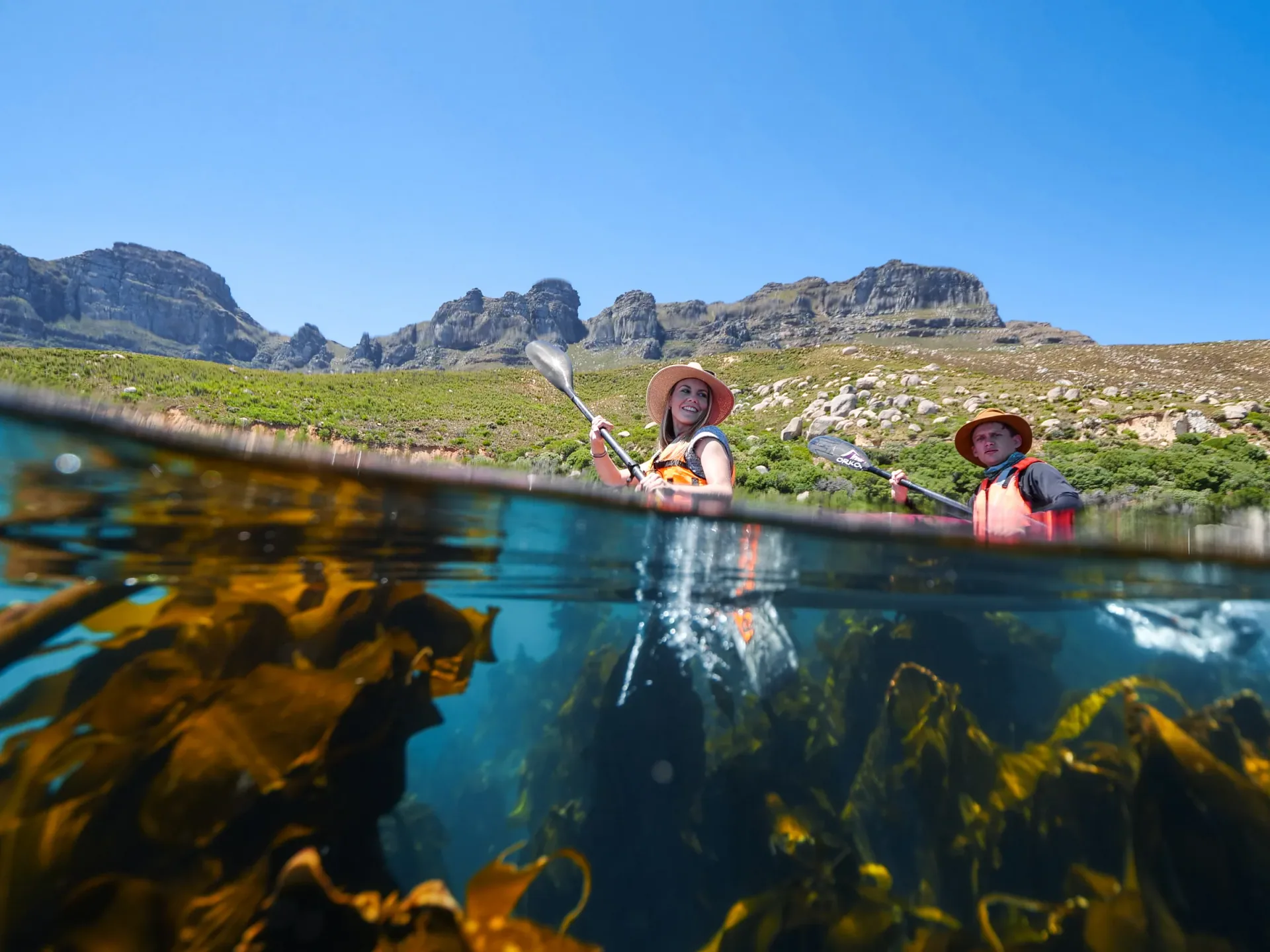
A kayak hull gliding over golden kelp fronds in clear water

The kelp forest — everyone’s home

The golden sea-bamboo forest beneath your hull shelters octopus, rock lobster and shysharks, feeds the seals, and calms the swell — the same Cape kelp forests made famous by My Octopus Teacher.

Sightings are never guaranteed — they remain wild and free. We keep a respectful, legal distance from whales, but seals and dolphins make their own rules and often come to us.

When to come

A year on the water

Something is always happening in the bay. Here’s what each season brings.

  • Summer

    Dec – Feb

    • Heaviside’s and dusky dolphins on calm early mornings
    • Sunfish basking at the surface
    • Jellyfish blooms drifting through clear water
    • Seabird feeding frenzies over bait balls
  • Autumn

    Mar – May

    • The glassiest water of the year — our secret season
    • Seals and dolphins on most trips
    • The first humpbacks pass by on migration in late autumn
  • Winter

    Jun – Aug

    • Southern right whales arrive to calve in Cape waters
    • Humpback whales stream past on their northward migration
    • Seals and Heaviside’s dolphins stay all winter
  • Spring

    Sep – Nov

    • Peak whale months on the Atlantic Seaboard
    • Gannets and terns dive-bomb the spring bait runs
    • Sunfish return as the water warms

Come say hello

Meet them from a kayak

Every trip is approximately 2 hours on the water, fully guided, from R600 per person — launching from the Beach Shed at Three Anchor Bay. Morning trips give you the best chance of wildlife.

Get in touch

Let’s get you on the water

We meet at the Beach Shed, Three Anchor Bay Beach — inside the Table Mountain National Marine Park. Arrive 30 minutes before departure. The safety briefing starts 15 minutes before departure. Allow roughly 2½ hours from arrival to return.

This is an enquiry. We’ll reply to discuss availability and pricing.

We use your details to reply and keep a contact record. Your name and email are stored securely with Resend. Privacy policy.